Showing posts with label Taliesin. Show all posts

Prophecies of the Bards

“This prophesy Merlin will make for I live before his time”.

So The Fool in Shakespeare's King Lear. Prophesy was an important medium of both magical and political rhetoric in the Middle Ages. Consider the case of Thomas of Erceldoune. He is mainly remembered today as Thomas the Rhymer who was carried off by the Queen of Faery and returned from her realm with "a tongue that could never lie". Robert Graves represented him as a true poet and his truth telling tongue as one which was gifted with the power of poetic utterance. But as the 14th century romance which appears to be the source of the later and much better known ballad about him makes clear, he also returns with power to transmit prophetic wisdom, in this case predicting the course of conflicts between England and Scotland.

If one role of the surviving druidic functions in Welsh society was that of the bard, or poet, another was that of prophet. Gerald of Wales has his awenyddion uttering divinations in their inspired poetic outpourings as they come out of a trance. The verses ascribed to Myrddin in The Black Book of Carmarthen and to Taliesin in The Book of Taliesin include prophecies, often of events supposedly predicted before they happened. It is thought that these were often the work of bards who are identified by their real names in their court poetry but who adopted personas of earlier legendary bardic figures to engage in prophecy or other inspired poetic activities. It is as if practising their craft as poets in their own names was one thing, but speaking while under the spell of the awen required their transformation into a magical alter ego.

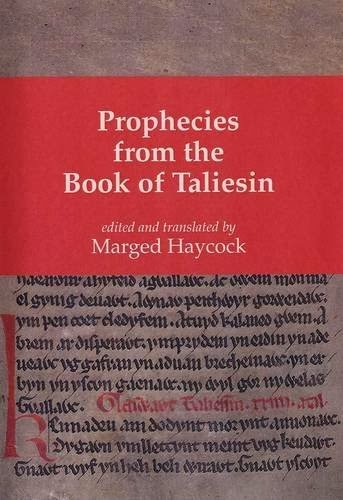
These thoughts are occasioned by the publication of Marged Haycock's Prophecies from the Book of Taliesin. This sequel to the earlier Legendary Poems from the Book of Taliesin focuses not so much on the utterances of the personality of a super bard but more purely on the business of prophesying the fate of the Britons in the face of invading Saxons, as if the voice were that of an early Briton foretelling those things related in the history of Gildas. As the editor points out, this is a view of the future that has the social function of history. Many are poems which hope for deliverance from adversity, often expressing a wish that refuge from enemies will be found and portraying the social breakdown that is experienced as a disruption of the natural ordering of things. They remind us that prophesy was a medium of social and political debate as much as of magical practice. These bards spoke for and from within their communities.

Taliesin Pen Beirdd


 Three shiploads of Prydwen went into it
Except seven, none returned from Caer Sidi
(extract from the Book of Taliesin manuscript)
*
Who – and when – was Taliesin?

This is a question with many answers and it is necessary to be clear about precisely what we are asking. Questions about Taliesin can best be discussed by identifying four separate but interacting categories:

The Historical Poet

This view of Taliesin sees him as the bard of the Brythonic chieftain Urien in the sixth century kingdom of Rheged which extended from Strathclyde (around modern Glasgow) down into Cumbria in northern part of the Lake District.  Of the mass of poems in The Book of Taliesin a few are still held to be possibly written by this poet. They mainly sing the praises of his lord in common with much of the poetry composed by tribal bards at this time.  But The Book of Taliesin is a fourteenth century manuscript collection given that name when discovered in a library in the seventeenth century. So the poems in it are not, in the form we have them, from the sixth century but later copies. As, initially, no-one could read them, they were assumed to be the work of a poet writing in Old Welsh. By now it has been established that most of the poems must be much more recent than that and all are, in fact, written in Middle Welsh in the manuscript versions we have.

If that was all that could be said, Taliesin would be no better known than Aneirin, another poet from what is now southern Scotland writing around the same time, who composed a series of elegies for the members of the Gododdin tribe who were wiped out in an attack on the Angles at the battle of Catraeth (modern Catterick in Yorkshire). That is, as with Aneirin, the debate about him would mainly be restricted to scholars attempting to date the poems from linguistic and historical evidence or discussing their contribution to the successive literary tradition in Welsh.

But Taliesin, like Myrddin, a third poet identified with same area, has been mythologised in a number of ways. And if the mythologisation of Myrddin as Merlin is at least clear and transparent, Taliesin has been transformed into a much more complex wizard for later generations.

The Legendary Bard

Many of the poems in The Book of Taliesin contain prophecies which link them to historical events in the ninth and tenth centuries. Others refer to stories that link them with prose tales in Y Mabinogi. Or with legendary exploits such as the raid by Arthur on Annwfn – the Brythonic Other World – to capture a magical cauldron. What is clear from consideration of the range of poems attributed to Taliesin is that, like Arthur, his name became a magnet for disparate material but also that he became the ‘type’ of the inspired poet. When later generations of Welsh poets in the Middle Ages looked back to the sources of their tradition, the place of beginning was ‘The Old North’, an area of southern Scotland and Northern England. Here the earliest poets  using Welsh after it had developed from the Brythonic language some time after the Roman occupation, were seen as forefathers of the Welsh bardic tradition  - one was called ‘Tad Awen’ (Father of the Muse) though none of his poems have survived. Collectively they were called the ‘Cynfeirdd’ (the earliest poets) and Taliesin became their iconic representative. So already, by the ninth century, he was being represented as a prophet and a magical figure who was present (whether imaginatively or otherwise) at various historical and legendary events from the beginning of the world to Arthur’s raid on the Other World. He was, in the Second Branch of Y Mabinogi, one of the seven who returned with the head of Brân from Ireland and sojourned with that head in Gwales in a timeless suspension of the everyday world. This is the poet as ‘awenydd’, an inspired individual such as those described by Gerald of Wales in the twelfth century, going into a prophetic or visionary state. He could now be regarded as the Spirit of Poetry.

The Wondrous Boy

At some point, inevitably, Taliesin entered the folklore tradition. The familiar story about Gwion Bach being given the job of stirring the cauldron of the witch Cerridwen and gaining universal knowledge by tasting a drop of the contents is a familiar motif. As is the sequence of shape-shifting as Cerridwen chases him and each turn into something different until she, as a hen, gobbles him up when he is disguised as a seed. His rebirth from her womb, his survival in his new identity as Taliesin, and his subsequent exploits at the court of Maelgwn Gwynedd, link this story to the legend of the gifted poet. In one sense this is just another example of the ‘magnet’ effect mentioned above, with the name Taliesin simply being attached to existing folk tale motifs. But in another sense it indicates how the figurative shape-shifter has become a ‘type’ not just of the Spirit of Poetry but the Spirit of Wales.

The Cultural Icon

The novelist and cultural critic Emyr Humphreys wrote a cultural history of Wales called The Taliesin Tradition. He uses the figure of Taliesin to represent Wales itself and in particular its literary life. The literary magazine published in Welsh by the Welsh Academy is simply called ‘Taliesin’. He was already seen as quintessential to Welsh identity long before he was also appropriated by the modern pagan community as a ‘Celtic Shaman’ and although the term itself has little meaning in the Welsh tradition, at least part of what it might indicate  is covered  by Gerald’s description of ‘awenyddon’. Appropriating to paganism the poet of The Book of Taliesin is difficult not least because he firmly identifies himself as a Christian. But the bardic tradition of someone who represents the Spirit of Poetry including the talent for inspired speech is, I suggest, quite enough to be going on with. Patrick Ford puts it like this:

“Clearly the tales of Gwion Bach and Taliesin cannot be lightly dismissed as “folktale” or late developments. Perceptible in them and in their attendant poems, despite the layering of successive generations and external influences, lies the myth of the primeval poet, in whom resides all wisdom.”

Quite so.

***

The poems ascribed to the bard of Urien Rheged were published by Sir Ifor Williams The Poems of Taliesin (English edition, 1968).
Other poems have been edited by Marged Haycock : Legendary Poems from The Book of Taliesin (2007) -The Welsh text with line by line translation and extensive commentary – an essential edition.

The quotation from Patrick Ford is from the introduction to his edition of Y Mabinogi and Other Medieval Welsh Tales (1977) which contains the story of Gwion Bach and Taliesin.


TALIESIN


Taliesin is conjectured to be a sixth century bard of Urien, the ruler of Rheged, but has taken on a status beyond this. The 'Book of Taliesin' is a collection of poems of a prophetic nature some of which, though not all of which, may be by such an historical personage. But he has become a symbolic character. Many know the story (in fact from the sixteenth century) that he underwent several changes of form (in accordance with a well tried folklore formula) while - in his original persona as Gwion Bach - being chased by the witch Cerridwen when he tastes rather than simply stirs the contents of her cauldron. His eventual transformation into the inspired bard is a million miles away from the conjectured historical poet.


But it's a good story and has made him emblematic of metamorphosis. Emyr Humphreys uses him in just this way as a symbolic representation of Wales in his cultural history The Taliesin Tradition. No fantasies about celtic shamans here, just the astute use of a cultural icon. Staying with imaginative fiction, the novelist John Cowper Powys presents him as a brilliant cook (clearly a familiarity with cauldrons is useful here!). But like most of Powys's characters, he is an extension of the author's life illusion:


John Cowper Powys


"Taliesin had indeed worked out for himself ... a really startling philosophy of his own. This philosophy depended upon a particular special use of sensation; and its secret had the power of rendering all matter sacred and pleasure-giving to the individual soul." [from his novel Porius]


This has as much to do with the .magical quest' of J.C. Powys than anything else. Like that poem in which Taliesin is said to claim being all things in all places, Powys lived his life by just such a view of the world, but one in which ordinary things were transformed in mythic fashion. As he says in his Autobiography (itself a great work of mythic fiction) :


"Posts, palings, hedges, heaps of stones -

they were part of my very soul."


As for the historical Taliesin, here's poem I wrote quite some time ago exploring his provenance:


Taliesin


Urien Rheged’s bard, I lit a spark

In the Old North where the dark

Came early for comrades cradled

In Cymru’s egg

and an Easter that was addled.


***


Still I sang my songs for him –

Not prophecies of the coming gloom

But celebrations of munificence,

Spells cast over the abyss

in complaisance.


Listen:

Riches fall from his hand

Like spray cascading to the sand,

Beads trickle into pockets

Of poets, not gleanings got

From the chaff but gifts to lift

The heart even of strangers

In his hall. How many times

I have told him this:


“Until I gasp my last breath

And stare in the face of death,

My life wont be worth living

If I don’t praise Urien.”


This praise

For meat and mead

But not for God

Is my lord’s due, my rent

To life as it is lived here, a tithe

Of song apart from the nine that are sung

Secretly where the silent harp is strung.


***


They call this place Eden

And the river runs like silk

on its silty bed.

Light hangs in the air

late on midsummer nights

Bats flicker through the bridge’s

old stone arches.

This is shape-shifting time, hovering

on borders of history, place and occasion.


A motor-biker leans his steed

Into the curve and over the bridge

Heading for the mead hall.

A huge extractor fan wafts chip-fry onto the night air


But not here;

The vale of Eden widening westward

To Solway and Scotland:

Idon in Rheged

Running with the blood of the slain

Like wine for the victory feast.


***


Over the sea-river

In Galloway

Mary made peace with her God

But not her people

At the abbey of Dundrennan

And sailed from Scotland.


Rheged a realm divided

Taliesin’s voice dead in the lands

Of Urien, Mynyddawg and Gwallawg:


A Tudor rose;

Rules in London.


Notes:

Taliesin is supposed to be the bard of Urien of Rheged, a sixth century early-Welsh speaking area in the area now covered by Strathclyde in Scotland and northern Cumbria.


This area of southern Scotland (including Gododdin in the east) was later known as 'The Old North' by the medieval bards of Wales who looked back to the 'Gogynfeirdd' (earliest poets) as their bardic ancestors.


The River Eden in Cumbria supposed to be Idon in Rheged.


Mary Queen of Scots left Scotland across the Solway Firth for the last time before being captured and imprisoned.


'Tudor' refers not only to this but to Henry VII who was seen as fulfilling the hopes of the Welsh that one of their number should once again rule the Island of Britain.