Showing posts with label Poetry. Show all posts

Horse Sonnets


{I}


The cottage is from an older world

Than the road that runs past it.

Sitting in its bedroom viewing trees

In the far distance I relish,

From my sick bed, the Sunday

Quietness in this busy time of the world

As if the noise had been carried away

By the analgesic that dissolves my pain.


And in the afterglow of this moment

Bridged by the growing and the shrinking

Sound of a car, the quiet returns

With a clatter of hooves on the road

Which I know I can share

With those others that lived here before.


{II}


And then the strangeness of it all, the ghostly

Clop of those hooves and the reality of those horses.

With only the sound to go by I must reconstruct

That substantiality, the hard muscle and yellow teeth,

And the rider: I see a tall woman with a black hard hat.

Or I can refuse the specific location of sound in solidity

Posit riders from the spirit world, the wild hunt,

Phantom steeds in the quiet of the afternoon.


Even so, the imagination, capable of so much,

Returns to its roots in the real, reviews what it remembers

Making what I might see if I went to the window,

In spite of the semi-delirium of fever,

To wonder if horses from the Otherworld

Would have such hooves as beat the hardness of the road.


{III}

Ranging along the bridleways of being

Thoughts drift to an old story of a woman

On a white horse who came into the world

Much as my thoughts drift in and out of it:

Elusive, though she rode a straight path

At a steady pace, she would not be caught

By any who followed her save one she sought

And he only by asking her to stay awhile.


Then her horse stood, and she in the saddle

Conversed with her veil cast aside,

All her glamour revealed

So the pact was soon sealed

That in one year, if he came, she would be his bride

And so it was, though delayed till he showed his mettle.


{IV}


In the high field above the trees is a horse

We can visit, and in walking weather

We take her an apple and she comes to the gate

For it and each of the children force

Themselves to hold a piece in their palm and her nether

Lip slobbers them as she takes it, and they concentrate

On holding the hand out flat. Their hands are wet


When they climb from the gate with shining eyes

For they have touched another life and a world

That is not theirs beckons, but under their own skies

Where there are things to discover, banners to be unfurled.

We look out at them and the horse through a glaze

Which is between us and their country and its untrodden ways.


The Mari Lwyd and New Year


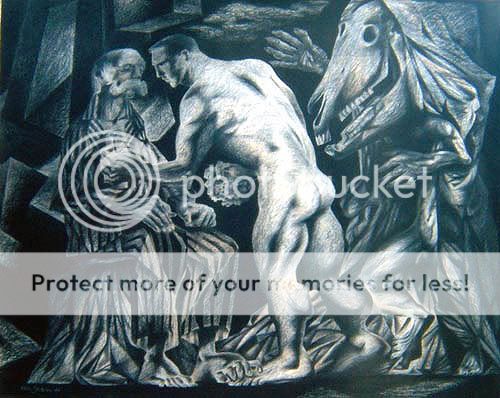
Mari  Lwyd , Horse of the Frost, Star-horse and White Horse of the Sea, is carried to us.

[…..]

Midnight. Midnight. Midnight. Midnight.
Hark at the hands of the clock.

A knock of the sands on the glass of the grave,
A knock on  the sands of the shore,
A knock of the horse’s head of the wave,
A beggar’s knock on the door.
A knock of a moth and the pane of light,
In the beat of the blood a knock.
Midnight. Midnight. Midnight. Midnight.
Hark at the hands of the clock.

The sands in the glass, the shrinking sands,
And the picklock, picklock, picklock, hands.

Midnight. Midnight. Midnight. Midnight.
Hark at the hands of the clock.


The above is a short extract from Vernon Watkin’s poem The Ballad of the Mari Lwyd first published in 1941. The whole poem covers more than twenty pages and alternates different voices, together with an ‘announcer’ to convey the New Year custom in Wales of carrying a horse’s head from house to house. The critic David Wright, and editor of Vernon Watkins poetry, calls it a : “dialogue and dialectic of the dead and living, the eternal and ephemeral, the spiritual and corporeal, the transcendental and material, art and philistinism, God and Mammon”. Here is the poet’s own note to the poem following its first publication:

“Mari Lwyd - the Grey Mari, the Grey Mare – was a white or grey horse’s head modelled in wood, painted, and hung with ribbons, carried from house to house on the last night of the year.
  The carriers were usually a party of singers, wits, and impromptu poets, who, on the pretext of blessing, boasting of the sanctity of what they carried, tried to gain entrance to a house for the sake of obtaining food and drink. The method they used was to challenge those within to a rhyming contest. The inmates would keep them out so long as they were not in want of a rhyme, but when they failed to reply to the challenger the right of entry was gained. The singers would then bring their horse’s head in, lay it on the table, and eat and drink with the losers of the contest.
  The singers came every year to my father’s house; and listening to them at midnight, I found myself imagining a skull, a horse’s skull decked with ribbons, followed and surrounded by all kinds of drunken claims and holy deceptions.  I have attempted to bring together those who are separated. The last breath of the year is their threshold, the moment of supreme forgiveness, confusion and understanding, the profane and sacred moment impossible to realize while the clock-hands divide the Living from the Dead.”
*  *
*
In spite of the well-established tradition of this custom at New Year, I have always felt it fitted more appropriately with Samhain. Not so much because this is supposed to be the Celtic New Year, but because that is when the Outer Dark most threatens the gathered light of the hearth. Was the custom shifted long enough back in the past to have come down to us as a festival of the calendar NewYear (when, after all, the Light is beginning to return) or am I missing something?

See also my discussion of the same poet’s Ballad of the Outer Dark HERE


Maes yr Onnen and The Birds of Rhiannon


Is the experience of the ‘spirit of place’ the experience of a particular place or the experience of The Spirit in a particular place? And how might such an experience be constructed? Consider this account from the poet R.S. Thomas who in 1947 visited one of the oldest nonconformist chapels in Wales on the banks of the River Wye. Sitting in the August sunshine while his wife Elsie did a sketch of the building (above) he had a revelation:

… it was two and a half centuries earlier on a fine August morning. And almost immediately I saw, I understood. As with St John the Divine on the island of Patmos I was ‘in the Spirit’ and I had a vision in which I could comprehend the breadth and length and depth and height of the mystery of creation.

Although he then says that he won’t try to put the experience into words he did, some time later, write the following poem:

Maes-yr-Onnen

Though I describe it stone by stone, the chapel
Left stranded in the hurrying grass,
Painting faithfully the mossed tiles and the tree,
The one listener to the long homily
Of the ministering wind, and the dry, locked doors,
And the stale piety, mouldering within;
You cannot share with me that rarer air,
Blue as a flower and heady with the scent
Of the years past and others yet to be,
That brushed each window and outsoared the clouds’
Far foliage with its own high canopy.
You cannot hear as I, incredulous, heard
Up in the rafters, where the bell should ring,
The wild, sweet singing of Rhiannon’s birds.

R. S. Thomas would develop the theme of the moment out of time that led to eternity often in his poetry. Natural images such as a constantly welling fountain or a tree continually shedding golden leaves were used to capture this moment. But here the reference is to ‘The Birds of Rhiannon’ in the Second Branch of Y Mabinogi whose singing suspends time so that those returning from Ireland with the head of Bendigeidfran then feast for seven years before proceeding to the island of Gwales for a further eighty years during which time is suspended.

In the medieval text this is presented as part of a story and socialized as the common experience of a group of people pursuing a specific purpose. Rhiannon’s birds are voices from Faery and, in texts from earlier times, this suspension of time is often presented as a crossing of the borders into the Otherworld. For modern writers, however, it is more likely to be a solitary experience, a ‘moment’ that is ‘forever’ (think of T.S. Eliot’s rose garden in ‘Burnt Norton’). It may or may not be a metaphor for a communion with ultimate ‘reality’, a god, the God, or a presence integral to a particular place. Waldo Williams, writing in Welsh, says ‘Gwyddom gan ddyfod yr Eiliad / Ein geni i’r Awr’ (We know in that Instant / We’re born to the Hour) and this neatly captures the general idea of a split second which is also eternity.

The content of the experience may be different for each individual, and at different historical periods or in different cultural contexts. But is it the same experience? And if so, if one experiences the singing of the Birds of Rhiannon, another the whispering of the Holy Spirit and yet another a wholly secular perception of a moment when time stands still, what accounts for this difference?


JEAN EARLE


A poet I have been particularly fond of over the years is Jean Earle. Born in 1909 and brought up in the Rhondda Valley in South Wales, she began writing poetry as a young women, but then wrote very little until she was in her sixties, publishing several volumes between A Trial of Strength (1980) and The Bed of Memory (2001). She died in 2002. The artlessness of her ‘naïve’ style belies a sophisticated use of imagery and reference that also characterises her work. One of her collections, Visiting Light (1987), provides a theme for many interpretations of her work as a poetry of light. Here, from that collection, is an extract from ‘The Woollen Mill’

Down the mill walls, light translated water,
The roaring silver
Over the wheel, that ground out light – and light –
Danced out of ancient cogs
From when they were young wood.
Such bright looking hurt …
When someone passed
I turned my head for relief of his shadow.


But as the final line of that extract also suggests, she was very conscious too of darkness and images of shadows also recur frequently in her work. In ‘Devil’s Blackberries’. for instance, where “Late pickers – cut off from sunset/In a ditch of brambles -/From earthed heels let fly/Their lengthening shadows” or the poem ‘Shadowlands’ where she declares herself “Obsessed by shadows …”.

For many years she worked as a secretary in the Bishop’s Palace at Abergwili near Carmarthen. In the poem ‘Walking Home’ she writes of her experiences there. Here is the final third of the poem:

My passing means no more
Than the shadows of firs
Brushing out a cold evening coming.
Fir shadow too, in the brown room,
Very sweet all day. One must ignore it
For the work’s sake. But afterwards what harm
If the shadow perceive a sudden flush
Between unhuman things …
The oak, the typewriter
In its business mask.
Were not its steely vitals drawn
Native as oak, from the hot earth?

A thousand blackbirds roost
In the drive bushes. Garden and churchyard
Are one broad round, steeped in ceremonial
Long before Christ. Often I feel the rites
Quilling like blackbirds …

This is an old, holy place,
Waging perpetual wars. I side with them –
But am unsure under what rising powers
I walk home.


Jean Earle reportedly communicated to an enquirer just before she died that “I believe I am a Christian”. Certainly she wrote about Light both directly and metaphorically in a way that suggests she conceptualised it in accordance with Christian belief. But her awareness of darkness and her uncertainty about those “rising powers” in the shadows also suggests that she sensed another dimension to the religious life.