"You shall receive the gift that your mouth and tongue speak, as far as wind dries, as far as rain wets, as far as sun reaches, as far as sea stretches, as far as the earth is -
except for
my ship
my cloak
Caledfwlch, my sword
Rhongomyniad, my spear
Wyneb Gwrthucher, my shield
Carnwennan, my knife
and Gwenhwyvar, my wife."
His ship is Prydwen, in which he sailed to the Otherworld (Annwfn) to get the cauldron of rebirth;
His cloak made the wearer invisible;
His sword's name suggests it cuts a breach in battle;
His spear's name means 'spear-striker';
His shield is the face of evening;
His knife's name signifies his fondness for its white haft;
… and his Wife
her name means 'White Enchantress'.
Such things he reserved for himself.
Anything else, had Culhwch named it, his generosity would bestow it.
(from Culhwch and Olwen)
Showing posts with label Arthur. Show all posts
Showing posts with label Arthur. Show all posts

Tales of Arthur
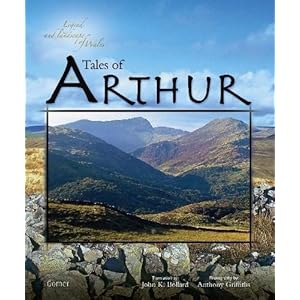
Earlier this evening John K Bollard read from his translation of the Arthurian tales contained in the collection of medieval Welsh tales known as 'The Mabinogion'. This took place in the campus bookshop at the University in Aberystwyth. He was joined by his wife Margaret Lloyd who read from her own collection of poems based on Arthurian themes and also by Anthony Griffiths whose photographs accompany the translations and who has also published a book of photographs capturing the wildness of Elenydd, the mountain fastness at the centre of Wales. Anthony Griffiths, an accomplished musician, entertained those who attended by playing his guitar. It was, then, a multi-valent event.
John Bollard, in breaking up the 'Mabinogion' tales into three volumes, also breaks the corporate identity bestowed upon them by Lady Charlotte Guest when she published the first translation in the Nineteenth Century. The eleven tales that make up the corpus are only really a corpus at all in that they were discovered bound together in manuscript collections known as The Red Book of Hergest and The White Book of Rhydderch. The 'Four Branches' of Y Mabinogi certainly form a group and may be by the same author. These formed the first of the volumes translated by Bollard together with Griffiths' photographs which themselves underline how deeply rooted in the landscape of Wales these tales are. By the second volume Companion Tales to Y Mabinogi, a series 'Landscape and Legend of Wales' had been established. Anthony Griffiths' photographs again researched the places in 'How Culhwch Got Olwen' and the 'native tales' and it was clear that a mythic presentation of landscape was emerging from the interaction of text and photographs.
In the latest volume Tales of Arthur this interaction is more problematic. In these tales we are very much in the medieval 'present' rather than a mythic past. Arthur is a king or emperor and his men are knights. Like the French romances with which these three tales can be compared the knights ride off from Caer Llion on Usk into enchanted landscapes with little specific correlation with the actual geography of the land. Photographs here were clearly a problem and many of the pictures have no specific links with the text or illustrate Arthurian place names, making the point that these show how much Arthur is part of the geography of Wales even if that geography cannot be specifically linked to the tales. This, in itself, underlines the justification for breaking up 'The Mabinogion'. These tales, certainly, are different from the other tales in the collection and deserve to be presented in their own right.
Vexilla Regis / Sir Bedivere's Horse

Vexilla Regis (pencil & watercolour)
by David Jones
While on the subject of Arthurian deposits ... One thing leads to another and so here is a delightfully eccentric way of 'interpreting' the painting above.The poet Jean Earle wrote this poem in her eighties with all the willed mischievousness of a young tyro.
Sir Bedivere's Horse
The title of the painting comes from a Latin hymn Vexilla Regis prodeunt ... (Forth come the standards of the King) written in Gaul in the 5th century. The symbolic imagery of the painting refers, among others things, to the Crucifixion (there's a robin with a 'bloodstained' breast). But what about those horses? Jean Earle was not so eccentric in the light of this from David Jones' letters:"the rushing ponies are, more or less, the horses of the Roman cavalry, turned to grass and gone wild off to the hills. This idea, probably, in turn comes from something in Malory's Morte D'Arthur when, right at the end, after the death of Guenevere, and the break up of the round table, Lancelot and the other knights let their armed horses free to roam where they will ... and gone off to be hermits and the like." (Dai Greatcoat p.149 ...)
David Jones, dreaming ‘Vexilla Regis’.
Painted the souls of trees
On lumpish hills, such as spiral
My birthplace. Beyond the foremost,
Tallest and roughest Tree,
Run the wild horses.
Dreamer myself,
I know one is Sir Bedivere’s horse.
I was once Sir Bedivere’s squire.
How we sagged, after we lost Arthur!
Wandering purposeless –
The forest stiff in a winter
Like glass fur. So scarce the forage ….
Sir, at his blackest hour,
Poorly with fever,
Hardly spoke, grieving. The horse thin,
Carrying both of us. “At last”, I said,
“We are coming
To World’s Edge. My brother lives near,
In a fortified house.
You could lie down?”
So we had shelter. But Sir, brooding,
Rode his dear creature out,
Returned alone. “I have freed him,
To your hills”. “But where’s the bridle?”
Bed, not at all himself,
Had left it hanging.
“Sir, he’ll starve! Caught in some coppice,
Like the ram sacrifice
In holy writ”. Sir refolded
His great hurt as he did his long legs,
Closed off his mind from me,
Covered his face.
People there thought it a shame, to live
Stuck with a darkened knight
Who licked his wound while cursing
Lost battles. The pain Sir Bedivere
Nursed was as everywhere
As the King’s grave ….
Life will go on. I was young, afire –
Finding the horse, I’d go
Adventuring. Try my mettle
Some new road. Sir Bed would not miss
All my uncourtly ways.
Scarce a brilliant squire ….
Where the Honddu, in a rushy foaming
Hurries its little fishes,
I found the horse – fast in a tangle
Of witchwood, that might have killed him,
Strangled him with the reins,
Had I not come.
Ripe for love, sniffing his sweat and steam,
Gathered the wild mares,
Enticing him. It needed
My utmost muscle and finesse –
Muddied and almost thrown –
Till I unwound him.
Crazed for freedom; and the whinnying, hot
Mares – oh, the animal
Was as myself, was a brother
In prison. I slashed the brute loose.
Whatever might curb his life
Now – I would not.
With the soft act, Sir Bedivere’s
Quixotic chivalry
Came home to me. It was oddly
Endearing. Return to him, then –
Muddy; but maybe not
Quite a bad squire?
Such whiffs of mediaeval spice
David Jones loved: yet his fey brush
Deft with running shapes,
May not have known –
Through the layered myth –
Which was Sir Bedivere’s horse.
Painted the souls of trees
On lumpish hills, such as spiral
My birthplace. Beyond the foremost,
Tallest and roughest Tree,
Run the wild horses.
Dreamer myself,
I know one is Sir Bedivere’s horse.
I was once Sir Bedivere’s squire.
How we sagged, after we lost Arthur!
Wandering purposeless –
The forest stiff in a winter
Like glass fur. So scarce the forage ….
Sir, at his blackest hour,
Poorly with fever,
Hardly spoke, grieving. The horse thin,
Carrying both of us. “At last”, I said,
“We are coming
To World’s Edge. My brother lives near,
In a fortified house.
You could lie down?”
So we had shelter. But Sir, brooding,
Rode his dear creature out,
Returned alone. “I have freed him,
To your hills”. “But where’s the bridle?”
Bed, not at all himself,
Had left it hanging.
“Sir, he’ll starve! Caught in some coppice,
Like the ram sacrifice
In holy writ”. Sir refolded
His great hurt as he did his long legs,
Closed off his mind from me,
Covered his face.
People there thought it a shame, to live
Stuck with a darkened knight
Who licked his wound while cursing
Lost battles. The pain Sir Bedivere
Nursed was as everywhere
As the King’s grave ….
Life will go on. I was young, afire –
Finding the horse, I’d go
Adventuring. Try my mettle
Some new road. Sir Bed would not miss
All my uncourtly ways.
Scarce a brilliant squire ….
Where the Honddu, in a rushy foaming
Hurries its little fishes,
I found the horse – fast in a tangle
Of witchwood, that might have killed him,
Strangled him with the reins,
Had I not come.
Ripe for love, sniffing his sweat and steam,
Gathered the wild mares,
Enticing him. It needed
My utmost muscle and finesse –
Muddied and almost thrown –
Till I unwound him.
Crazed for freedom; and the whinnying, hot
Mares – oh, the animal
Was as myself, was a brother
In prison. I slashed the brute loose.
Whatever might curb his life
Now – I would not.
With the soft act, Sir Bedivere’s
Quixotic chivalry
Came home to me. It was oddly
Endearing. Return to him, then –
Muddy; but maybe not
Quite a bad squire?
Such whiffs of mediaeval spice
David Jones loved: yet his fey brush
Deft with running shapes,
May not have known –
Through the layered myth –
Which was Sir Bedivere’s horse.
David Jones' Arthur

And what of Arthur in the 20th century (it is too early to speak of the 21st)?
There were T.H. White's whimsical offerings The Sword in the Stone and The Book of Merlyn but, amusing as they might be, and delightful in their own way, they cannot constitute any sort of serious Arthuriad.
There were the writings of Charles Williams, which certainly deserve to be taken seriously. His Arthurian Torso attempted an analysis of the significance of the material and his long poem Taliessin Through Logres, if eccentric, does attempt a contribution to the tradition rather than a restatement of it. But both of these, in literary terms, have vanished without a trace.
Which leaves David Jones. His luminescent account of Gwenhwyfar praying in a chapel at Christmas occupies a significant point in the labyrinth of his spectacularly labyrinthine writing The Anathemeta. Then there are the two poems (though called 'fragments') published in The Sleeping Lord. 'The Hunt' is an evocation of Arthur in the medieval Welsh tale 'How Culhwch Won Olwen' while 'The Sleeping Lord' poem itself presents Arthur as a densely symbolic figure.
These works deserve to be better known. T.S. Eliot put Jones in the same league as Ezra Pound and himself. But, in spite of 'The Waste Land', with its echoes of Jessie Weston's study of the grail legends From Ritual to Romance, in spite of Pound's self-conscious echoes of The Odyssey, neither of these came as close to a deep engagement with the mythological deposits they used as did Jones. Perhaps Joyce - a particular favourite of Jones' - did in thoroughly modernising his mythological engagement with the soul of Ireland.
Jones' "what's under works up" is nowhere more concisely expressed than in his Arthurian poems. In 'The Hunt' , Arthur hunts the boar Trwyth and engages him with due respect "life for life". 'The Sleeping Lord' on the other hand, presents a more passive figure, the very essence of the island of Britain rather than it's defender. Just listen to Jones cadences here and savour the wealth of symbolic detail:
(from the conclusion of a poem covering 26 pages):
Yet he sleeps on
very deep in his slumber:
how long has he been the sleeping lord?
are the clammy ferns
his rustling vallance
does the buried rowan
ward him from evil, or
does he ward the tanglewood
and the denizens of the wood
are the stunted oaks his gnarled guard
or are their knarred limbs
strong with his sap?
Do the small black horses
grass on the hunch of his shoulders?
are the hills his couch
or is he the couchant hills?
Are the slumbering valleys
him in slumber
are the still undulations
the still limbs of him sleeping?
Is the configuration of the land
the furrowed body of the lord
are the scarred ridges
his dented greaves
do the trickling gullies
yet drain his hog-wounds?
Does the land wait the sleeping lord
or is the wasted land
that very lord who sleeps?
Arthur of Britain?

David Jones, in his long essay 'The Myth of Arthur' asserts that "the tradition of Arthur was, for the Welsh, an authentic part of their historical mythus, whereas for the English it was a literary convention mixed with local traditions as at Glastonbury ...". It is easy to lose sight of this fact. 'King Arthur and his Knights' are all too familiar. It is likely that the source material for much of the medieval Arthurian romances was Geoffrey of Monmouth's History of the Kings of Britain which was written in Latin in the Twelfth Century (Breton sources have been suggested for the French romances of Chretien de Troyes but these are not extant). Geoffrey drew upon an older 'historical' source in the work of the ninth century chronicler Nennius. It seems that he also drew upon Welsh material, some of which has survived and some has not. It is likely that he filled in both the historical and the fictional gaps by making things up. Certainly he drew things together that had not previously belonged together, bringing in Merlin from a quite different set of literary and legendary material. But his Arthur is at least a Brythonic war lord in a country that was divided both within itself and by invasion. The medieval romance tradition ignores this context and makes him very much a contemporary figure (to them) ruling a medieval court whose knights get mixed up in the Holy Grail legend. As for the great English Arthurian cycle, it is based very much on this pan-European material in spite of its sinewy engagement with the realities of knightly conflict (Sir Thomas Malory wrote his Arthurian cycle while in prison having fought in some the the decisive battles of the Wars of the Roses). Malory's constant refrain is "so the Frensshe book maketh mencyon". The last books of the cycle (based in this case partly on the earlier English alliterative Morte Arthur) are a fast-moving and tragic account of illicit love and its consequences. But in the hands of Tennyson in The Idylls of the King they became a Romantic and dreamy expression of Victorian neo-medievalism. This is this 'English' Arthur that survived into the cinema age, though some more recent films have put back the harder edge of Malory's gritty realism.
But still all this is a million miles away from How Culhwch Won Olwen, or the Arthurian references in early Welsh poetry. But what did survive into the later medieval tradition was the idea that, as Malory puts it:
"Som men say in many partys of Inglonde that Kyng Arthure ys nat dede, ...... Yet I woll nat say that hit shall be so, but rather I wolde sey: here in thys worlde he chaunged hys lyff. And many men say that there ys wrytten uppon the tumbe thys:
HIC IACET ARTHURUS, REX QUONDAM REXQUE FUTURUS"
The idea of a grave for Arthur in the Englynion y Beddau is 'anoeth' a word that has caused some problems of interpretation. In modern Welsh it usually means 'unwise' but can also mean 'strange'. In earlier Welsh it also had the meaning 'marvel'. So 'An unwise thought ,a grave for Arthur' or 'A great marvel, a grave for Arthur' are both possible. But the general idea is that Arthur doesn't need a grave because he is not dead but sleeping and will come again to re-claim the sovereignty of the island of Britain in a time of of need. It was an idea that the Welsh adhered to but it was firmly knocked on the head by Edward I when he had two bodies removed from a tomb at Glastonbury in 1278 in the middle of a period of conflict with Llywelyn ap Gruffudd the last native Prince of Wales. Here are Arthur and Guenevere says Edward, so he's not coming back. In such ways do myth and legend become the stuff of politics, which I suppose gets as close to the world of a Brythonic warlord as we can get.
Subscribe to:
Posts (Atom)